Pakistan–Afghanistan Relations Enter a Dangerous New Phase
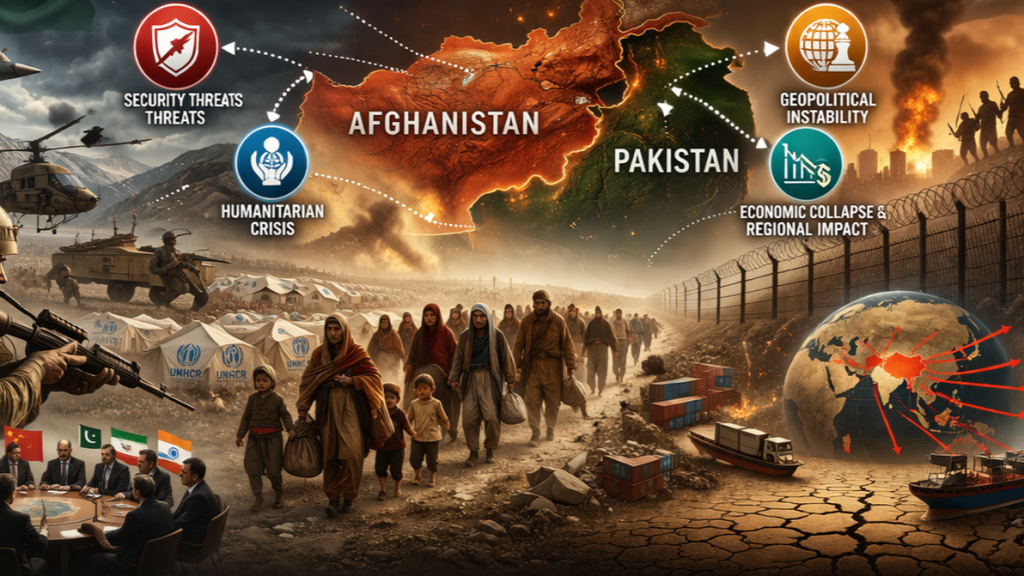
The relations between Pakistan and Afghanistan have come to a dangerous state of affairs. It used to be about cross-border militancy, border management, and an increasing lack of trust on both sides, but now it has become a vicious circle of actual military operations, countering, and stronger accusations. The airstrikes in Kunar and Helmand on 1st October 2026 are thus significant not just on the basis of immediate casualties, but because they represent a deeper strategic failure in the region of two neighbouring states whose security is indissolubly linked.
The Tehrik-e-Taliban Pakistan (TTP) lies at the heart of the clash. Islamabad has repeatedly asserted that TTP fighters have their bases in Afghanistan and continue to launch attacks from there in Pakistan. Kabul denies this and claims that Pakistan is trying to wash its dirty linen in public. The disagreement has turned into the main obstacle in bilateral relations. The problem is more and more being seen as a threat to Pakistan’s security and the Afghan government of the Taliban is considering the Pakistani military’s presence in Afghanistan as a violation of national territory. The conflicting accounts have left little room for ongoing collaboration. Council on Foreign RelationsSuch a recent escalation is a clear indication of the seriousness of the issue. The strikes in Kunar and Helmand were aimed to destroy the hideouts of TTP and Baloch insurgents, killing 22 militants, Pakistani authorities said. But Afghan authorities claimed civilian casualties. At least 10 civilians were killed, mostly children, and 9 others injured, the United Nations Assistance Mission in Afghanistan (UNAMA) confirmed. UNAMA also pointed out that the civilian impact of cross-border violence is a far greater issue and in 2026, over 1,100 civilian lives were reported to be lost and injured in Afghanistan due to cross-border violence. Reuters
The figures show one of the darkest threats to the current conflict: irrespective of whether it is military operations that are targeting militant organisations, repeated cross-border strikes have humanitarian, political and strategic consequences. Afghanistan’s civilian casualties further inflame already discontent among Afghans, further fuel anti-Pakistan sentiments and complicate diplomatic engagement. They also give the Taliban leadership more reasons to adopt a tough stance on Islamabad. But for Pakistan, the current spate of militant attacks poses the same pressure of proving threats emanating from the border can’t be tolerated. This creates a security dilemma where what’s done for security is seen as an attack by another.The deterioration is especially notable as both Pakistan and the Afghan Taliban were at one time considered strategic partners. Their relationship has never been so simple as that description implies, though. When Taliban seized Kabul in August 2021, initially, Pakistan had high hopes that a “friendly” government in Afghanistan would be able to provide better security at the border and limit the influence of India. Rather, the activities of TTPs were growing into an escalating issue. The organisation is ideologically and historically tied with the Afghan Taliban, and it still has its leadership, its goals and its organizational structure. Hence, Pakistan’s hopes of a bold move from Kabul to curb or dismantle TTP networks have run counter to the unwillingness or ineptitude of the Taliban government to oblige Pakistan. Reuters
The problem has since grown from the TTP. Pakistan has also connected Afghan territory with Baloch militant groups and Afghan authorities have also made allegations about armed groups that enter Afghanistan from Pakistan. In late September 2026, Afghanistan said it had downed 28 armed men, including Islamic State fighters, who had infiltrated its borders from Pakistan into the Nuristan region. Islamabad has denied any such allegations of the Afghan side in the past. The contemporary dynamics of the relationship are not a one-way affair of militant issues, but are now seen from the other side’s perspective in the light of hostile armed activities. Reuters
But there has been no structural change to this mistrust with repeated ceasefires. Different countries have also contributed to de-escalation efforts including Qatar, Turkey, Saudi Arabia and China. However, these temporary ceasefires have been interrupted many times by renewed outbreaks of violence because the central problem, which is how to cope with militant groups along or over the border has not been resolved. While diplomatic interaction may prevent escalation in the short term, it is not a replacement for a viable security mechanism. Unless intelligence is shared, there are no tangible assurances on militant operations and no agreed rules for governing border incidents, ceasefires will tend to be fragile.Economics impacts are also growing in severity. Afghanistan is heavily reliant on cross-border trade and transit through Pakistan; communities on both sides of the border are dependent on formal and informal economic and trading networks. Since October 2025, hostilities and border closures have impacted on civilian infrastructure, supply chains, transport costs, trade and humanitarian access, the United Nations has warned. Afghanistan is especially hard hit by these pressures, given that millions already are in need of humanitarian support. UNAMA
The continued conflict has significant costs for Pakistan too. The province of Khyber Pakhtunkhwa and Balochistan are already under serious security threat and the existence of a hostile western frontier imposes additional burden on the military, intelligence and economic resources. It also injects a dose of strategic uncertainty amid Pakistan’s multifaceted regional and domestic challenges for security, economic pressures, and balancing. So, a long military battle with Afghanistan will also come at a high price outside its borders.The regional impact should not be overlooked. China has significant economic and strategic stakes in both Pakistan and Afghanistan and has consistently championed peace and stability in the region. Central Asian countries need to develop reliable transportation links and stable international borders to deepen the connectivity below. The prolonged Pakistan-Afghanistan fiasco may harm regional trade, infrastructure cooperation and counterterrorism cooperation. It might also give opportunities to the militant organizations to exploit ungoverned or contested regions along the frontier.
The mission or goal of the immediate policy is not merely to prevent the next exchange of fire, but to avoid a lasting change in the nature of Pakistan-Afghanistan relations from a relationship of conflict and uneasy coexistence to one of conflict and permanent hostility. Military operations can break up a network of militants but they cannot themselves solve the security and political situation that enables the militants to regenerate. Kabul, on the other hand, has nothing to hope for in terms of stable ties with Pakistan if Pakistan is unable to respond to concerns of cross-border militancy.It is important to have direct conversation in order to implement a sustainable framework and to have a security arrangement that can be proved. Pakistan should get credible assurances that Afghanistan would not use its soil for an attack against Pakistan. Afghanistan should be assured that it will not be invaded with military force again and that its people are not going to be harmed again. There is also a need for a functioning mechanism between both sides for border incidents, intelligence exchange and investigating the militant activities.
The happenings of 2026 show the need to rethink the current strategy. With every fresh strike, militant assault, or retaliatory strike, the price tag on compromise grows higher. The risk is that the tactical responses lead up to a strategic confrontation which is hard to escape. As two countries that are geographically, historically, and economically tied together and linked by security and people, the solution to lasting hostility is long-term peace. Now, whether Islamabad and Kabul can get past the rhetoric of accusation and retaliation and make security co-operation workable is the real question here.