
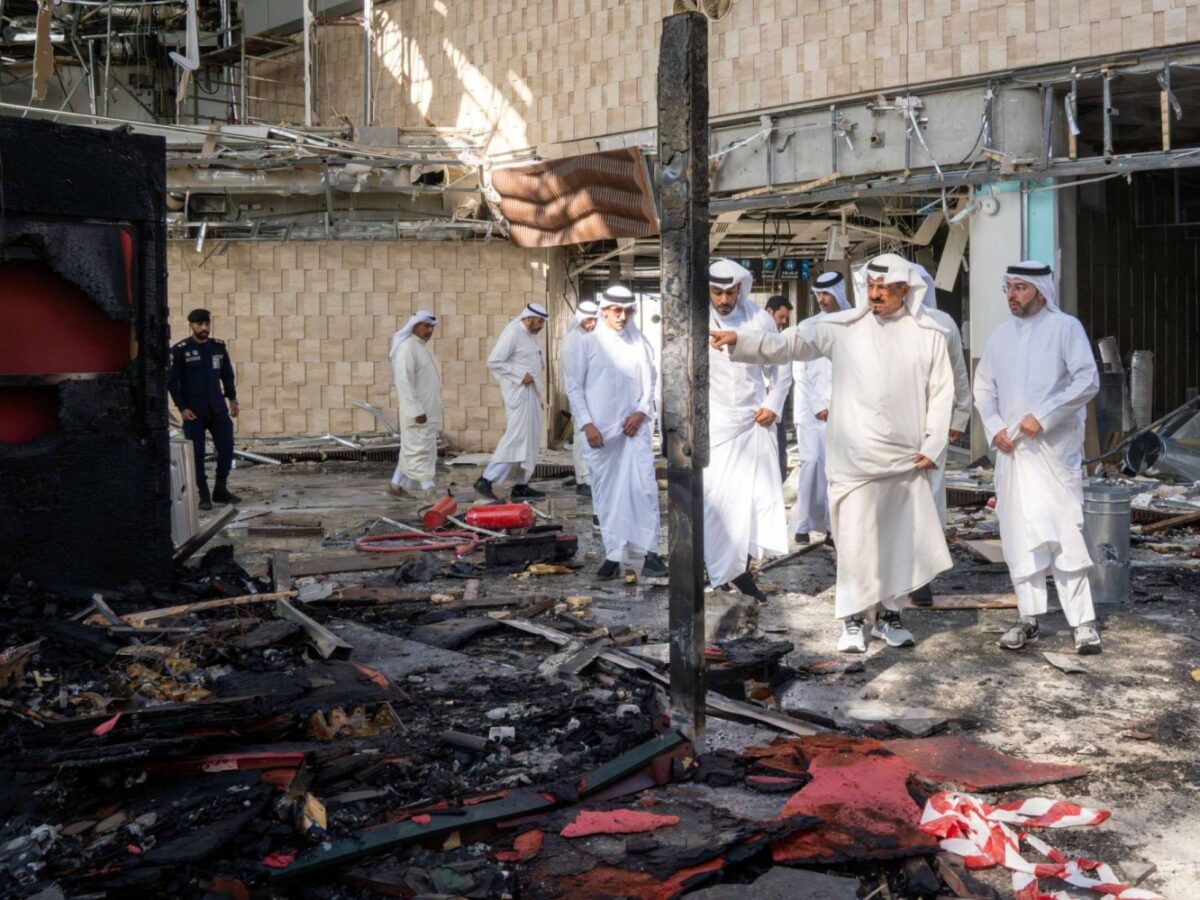


The drone and missile strike on Kuwait International Airport is one of the most obvious indications that the US-Iran ceasefire is in serious trouble. The initial attack at an airport is actually part of a broader escalation across the region involving Iran, the United States, Kuwait, Bahrain, Israel, Lebanon and the Strait of Hormuz. In the relatively peaceful kingdom of Kuwait, the attack claimed the life of one Indian national, maimed over 60 people and damaged a civilian passenger terminal, which made the kingdom a prominent battleground in the expanding conflict.
On 3 June 2026, an attack on Kuwait International Airport using Iranian drones and missiles was reported by the authorities. The attack left airport facilities damaged, leading to temporary shutdowns and loss of life for passengers, workers and civilians. The strike resulted in widespread damage to civilian facilities such as Kuwait International Airport and Kuwait Airways suspended flights temporarily, before restarting some operations from another terminal, Reuters reported. AP also reported that Iranian drones caused severe damage to the passenger terminal at the main airport in Kuwait, injuring dozens and killing one person. The health ministry has confirmed 63 injuries, some of which are serious, such as fractures, head injuries, amputations and blast injuries, according to CBS.It was later revealed that the deceased was an Indian citizen. This added a diplomatic dimension to the event as the attack was not confined to Kuwait or the United States, but it also had a negative impact on foreign civilians residing and working in the Gulf. India strongly condemned the attack and urged the end of such attacks, particularly those targeting civilian populations and civilian infrastructure. The casualty of a citizen of India – a reminder of how fast regional military escalation can lead to international repercussions not only in the region, but globally too.
The issue of responsibility is at the heart of the controversy. Kuwait and the U.S. blamed Iran for the attack. Kuwait termed the act “hostile aggression” and summoned the Iranian ambassador and ordered two Iranian diplomats out of Kuwait. Kuwait summoned the Iranian diplomats to the embassy and declared them persona non grata, and granted them two days to leave, CBS reported, calling the decision a response to the repeated attacks, which included missile and drone strikes on civilian and strategic facilities. Iran’s Islamic Revolutionary Guard Corps (IRGC) refuted charges of direct attack on the airport, but also asserted — without evidence — that the airport terminal was damaged by a failed US made interceptor. US Central Command dismissed this theory and said Iranian drones were involved in a purposeful attack.
This is a competing narrative that is significant. The Kuwait airport strike is not only a military incident, it’s also a political and information confrontation. Iran says it is retaliating for the U.S. military presence in the Gulf. The U.S. and Kuwait allege Iran’s moves to be undue attacks on civilian infrastructure. However, the best guess is that Kuwait and the US believed Iran was responsible for the attack, and Iran claimed the airport was damaged by US air defence systems and denied any responsibility for the attack.The airport strike came after a battle of arms between the U.S. and Iran. Reports say the U.S. military attacked Iranian military sites in the Strait of Hormuz on the island of Qeshm. Iran had also claimed destruction of an Iranian oil tanker by the US, which was described by US officials as a self defence operation. Iran then went on to accuse the US of attacking military sites in the Gulf, such as in Kuwait and Bahrain. The escalation encompassed US airstrikes on Qeshm Island, Iranian attacks near Kuwait and Bahrain, and the uncertainty over the possibility of a broader regional war breaking out again, Al Jazeera reported.
Bahrain also has special importance due to its hosting of the headquarters of the US Navy’s Fifth Fleet. The Revolutionary Guard of Iran admitted it attacked military bases and military facilities connected with the Fifth Fleet in the area and in particular its headquarters in the Fifth Fleet’s base. The US and Bahraini forces have stopped missiles and drones targeting Bahrain. The defence authorities in Bahrain have confirmed that they intercepted and destroyed three missiles and several drones fired by Iran, CBS reported. This is not the last escalation of the kind to happen in Kuwait. It was a wider Iranian effort to squeeze the U.S. military presence throughout the Gulf.The incident also highlights the fact that the current ceasefire is a weak one. A cease fire typically refers to a cessation or lessening of violence, but in the case of Qatar, Bahrain and Kuwait, there is clearly no cessation of violence. The U.S. declared the strikes defensive. Iran said that its reaction was “retaliation.” The airport in Kuwait was hit. Air defence was activated in Bahrain. This is an example of the fact that the ceasefire is not being a true peace agreement. It is more of a brief truce in a full war, with some attacks still going on, and justification being invoked by both sides.
The wider diplomatic situation is also unstable. The U.S. officials have hinted that negotiations with Iran continue, and Iranian officials have stated that there has been little or no real progress. However, Iranian Foreign Minister Abbas Araghchi told CBS that “no tangible progress” had been made with the peace talks with the U.S., but that communication with the U.S. had not been “totally cut off.” This establishes a dangerous paradox: One, political leaders continue to talk about diplomacy, and the other, military operations are still ongoing on the ground and in the air.
A major reason for the instability is the Strait of Hormuz. The strait is still a vital international energy route, and moves a significant portion of the world’s oil and gas supplies. Iran has a lot of leverage thanks to its ability to threaten shipping in Hormuz, while the USA’s blockade of Iranian ports puts pressure on Tehran. CBS reported that the US forces had rerouted 125 commercial vessels and disabled six more in the blockade of Iranian ports and vessels. This puts the conflict not just on the military agenda of regions, but also on the economic agenda of the global economy.The economic impact has already been felt. The attack prompted a sell-off in oil markets following further concerns over the security of the Gulf and the potential for disruption in oil supplies. Investor confidence was shaken by the latest missile and drone attacks and Gulf markets pulled back due to Iran war jitters, Reuters reported. Oil prices also trended back to $100 a barrel after the flare-up, CBS reported, as every additional military exchange in the Gulf puts additional strain on the global economy.
There’s another risk on the Lebanon front. The US-Iran ceasefire is being linked more and more to Israel’s military incursion in Lebanon. Iran has reportedly demanded that any “broader truce” include Israeli strikes in Lebanon, a stance that Israel doesn’t want to go for. The negotiations will be more difficult because there is no only one battlefield where a fight is taking place. It now connects Iran, the security of the Gulf, US military policy, Israeli strategy and Hezbollah’s presence in Lebanon.
This is the significance of the Kuwait airport strike. It reveals that the Gulf countries are no longer able to take for granted that their airports, airspace and civilian infrastructure will not be shielded from the US-Iran conflict. Kuwait and Bahrain are entangled in the conflict, due to their strategic alliance with the United States and their central role in the Gulf security system. While the intended targets may be military, missiles, drones, and air-defence interceptions still have the potential to inflict civilian damage, cause disruptions to aviation, and kill non-combatants.The attack also brings up a number of serious questions according to the international norms protecting civilian infrastructure. Airports are civil facilities, except when used for military operations. Even if military targets are in close proximity, states are responsible to preventing disproportionate harm to civilians. The incident in Kuwait thus generates judicial and humanitarian issues as it resulted in damage to the passenger terminal, injuries to passengers and workers, and killing of a foreign civilian. The dangers of rockets and drones being flown into civilian airspace are greater risks of miscalculation and escalation.
In general, the Kuwait airport strike is to be seen as a big stress test of the US-Iran ceasefire. It shows that the root causes of conflict – US military pressure, Iranian retaliation, the Strait of Hormuz blockade, the basing arrangements in the Gulf, Israel-Hezbollah fighting and faltering diplomacy – have not been addressed by the ceasefire. The worst thing about the present state of affairs is that both sides are citing defensive claims and are keeping going with what they believe are defensive measures, but are doing so at the very same time that they are taking steps that could lead to a broader war. The best answer is that the Gulf is in a stage of “controlled but unstable escalation. The conflict has not become a full-scale war, but it has definitely gone past the stage of negotiating. But Kuwait’s airport strike shows that even minimal communication can result in civilian casualties, diplomatic expulsions, flight disruptions, rising oil prices and increased regional insecurity. The Gulf will continue to be exposed to another unexpected escalation if the U.S., Iran and regional actors have not agreed upon a more robust and more effective ceasefire mechanism.
References
Al Jazeera (2026) ‘Iran, Kuwait, Bahrain hit: Is the war in the Gulf escalating again?’, Al Jazeera, 3 June.
Associated Press (2026) ‘Kuwait says Iranian drone attack hits its airport, killing 1’, AP News, 4 June.
CBS News (2026) ‘Live updates: Israel, Lebanon agree to renew ceasefire as Iran launches deadly attack on Kuwait airport’, CBS News, 3 June.
Reuters (2026a) ‘One killed in Iranian attack on Kuwait, airport terminal damaged’, Reuters, 3 June.
Reuters (2026b) ‘Most Gulf markets retreat on Iran war jitters’, Reuters, 3 June.

Research Associate, Pakistan House