
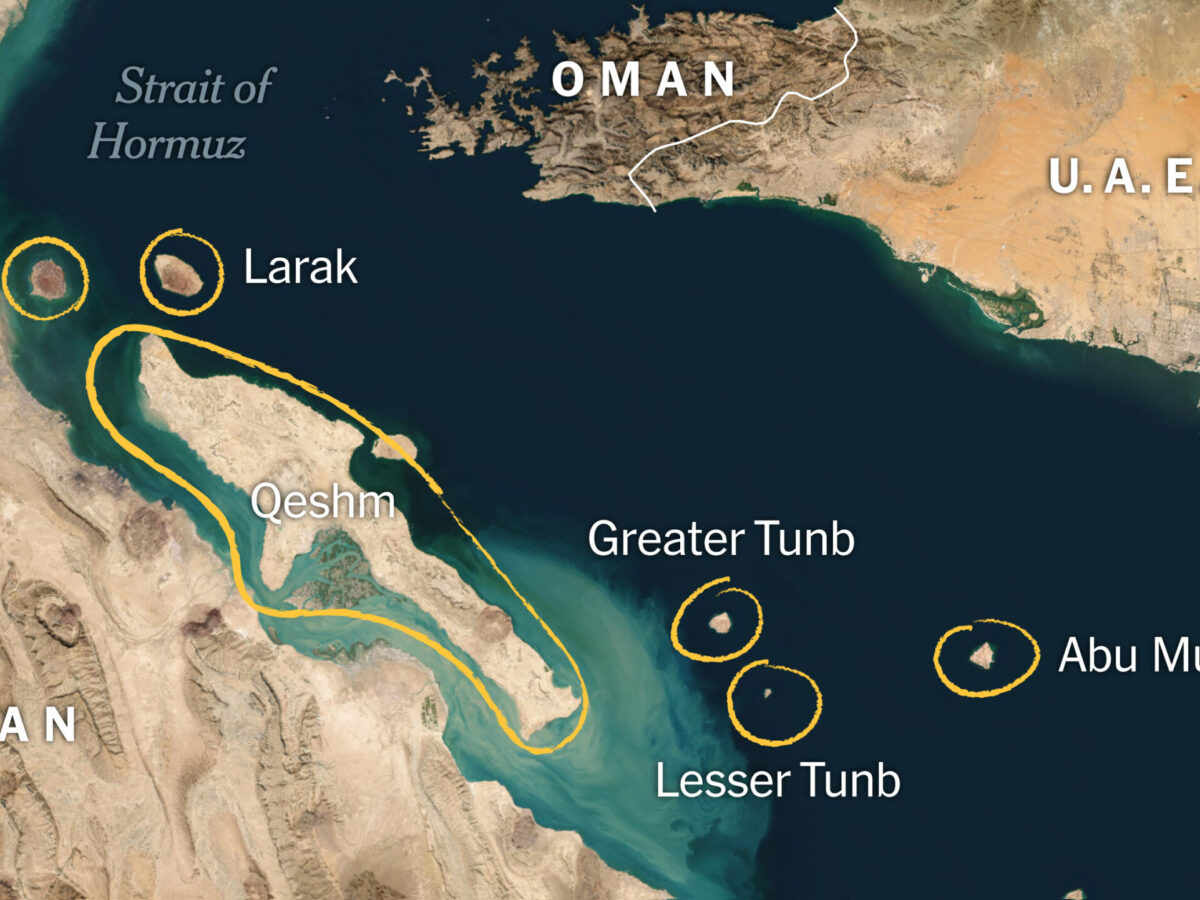


Introduction:
Strait of Hormuz is not just a maritime passage, it is a strategic chokepoint through which world energy security, great power rivalry and economic stability intersect. Events of 2026 has placed this strategic chokepoint at the center of global politics and economic stability.
Location:
This Strait lies in West Asia (the Middle East), between Oman and Iran, connecting the Persian Gulf to the Gulf of Oman, which opens into the Arabian Sea. This sea passage links the Countries of the Gulf, such as Iraq, Kuwait, Saudi Arabia, Bahrain, the UAE, and Qatar, to the Arabian Sea and beyond.
Why is it important?:
The Strait of Hormuz is the world’s most important oil maritime passage, connecting the Persian Gulf to the Arabian Sea. The Strait is not regional; it is a global economic artery. The Strait accounts for 20% of global oil trade. Through this 167km long and 39 km wide at its narrowest point, an estimated 30,000 vessels pass per year.
Major Middle Eastern exporters like Saudi Arabia, Kuwait, Iraq, and the UAE rely heavily on this channel to export their oil to international markets. While importing nations, primarily India, China, Japan, South Korea, and the European Union are dependent on these oil supplies. According to the US Energy Information Administration (EIA), approximately 20 million barrels of oil, valued around $500 billion in annual global energy trade passed through the Strait of Hormuz every day in 2024. According to EIA, this corridor accounted for one sixth of global oil production and one fifth of the world’s liquefied natural gas (LNG) in 2024, with Qatar accounting for the majority of the volumes.
Other than oil and gas, more than 30% of world’s Ammonia, 50% of Urea, 50 % of Sulphur and 20% and Diammonium Phosphate also passes through the Strait. Ships also carry a third of world’s helium which is used in multiple technologies.
Any disruption in the flow would impact the global economy, hiking fuel prices and affecting economies
Crisis of 2026
The following war between the US and Iran, which started on 28th February 2026, triggered the disruption of oil flows internationally. This is the first time that the Strait has been officially closed. Tankers are either delayed, rerouted, or temporarily halted. The traffic has plunged by more than 95% since the war began.
This disruption has surged oil prices above $100 per barrel, an increase of more than 40% compared to pre-war levels. While some analysts predict that prices could rise to $150 or even $200 a barrel if the closure continues. Tehran has clearly stated that the Strait is open to everyone except the US and its allies. The Iranian Minister of Foreign Affairs, Abbas Araghchi, stated that the Strait is “Open, but closed to our enemies.”
The international community has expressed serious concerns over the closure of the Strait. Countries like China, India, Japan, and South Korea, which heavily depend on oil imports, are being impacted by fuel shortages, price increases, and inflation in the transport and food sectors. Japan’s benchmark Nikkei 225 was up about 2.3%, while South Korea’s KOSPI was 2.6% higher. In Hong Kong, the Hang Seng Index was up to 0.7 percent.
Exporters in the UAE, Saudi Arabia, Kuwait, Iraq, and Qatar have been directly affected by export blockages, revenue losses, and economic pressure. Overall, oil prices have impacted international markets, causing global instability. While small number of ships have been passing through the Strait each day, the traffic still is far from it pre-crisis levels. Pakistani, Chinese, Turkish, and Indian Ships have been allowed to pass through the Strait, according to reports. Various other countries are in contact with Iran seeking for a safe passage for their carriers. The Foreign Minister of Iran, Abbas Araghchi, informed CBS (US television network) that Iran has been “approached by number of countries” regarding safe passage, and that “this is up to our military to decide.” Despite the closure of the Strait, Iran has earned nearly $5 billion in oil exports, nearly 55.2 million barrels in the past month. However this revenue is now at risk with United States naval blockade, as this could seriously damage Iran’s economy.
Recent developments:
US President Trump has announced that the US will implement a naval blockade after negotiations in Islamabad failed, asking other states to join the US Navy in blocking the Strait. Iran’s armed forces has responded by calling it “an illegal act” that “amounts to piracy”. Despite the US announcing a blockade on vessels of all nations entering or departing the Strait, Chinese tankers have crossed the Strait of Hormuz.
The countries have also rejected Trumps request to join the operation. Germany, Greece and France said that they will not engage in military operations. The United Kingdom’s Prime Minister, Keir Starmer, also told the media, “We will not be drawn into the wider war.” Starmer has announced diplomatic engagement co-hosted with France to be held this week, aiming to end the war on Iran and secure the safe passage for future shipments. According to recent reports, Iran and the US might engage in another diplomatic effort to reach an agreement. The international community is relying on these diplomatic engagements to prevent further escalation and the reopening of the Strait of Hormuz. The Strait of Hormuz continues to be the linchpin of this war. It has shifted the focus of the war and intensified global vulnerabilities. Any disruption to the flow of capital will pose a serious risk to international markets and global economies.
