
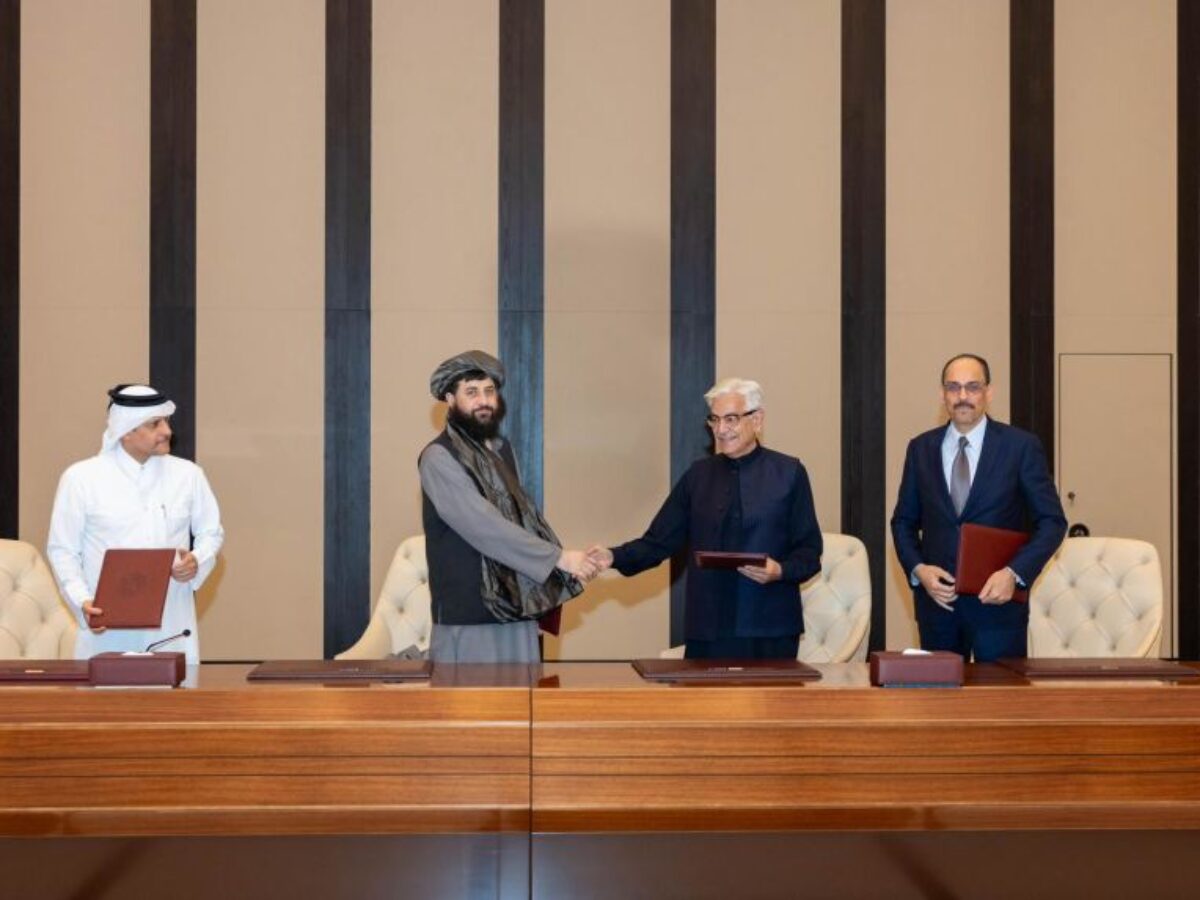


Pakistan and Afghanistan are currently at a crossroads. Following some of the most significant border conflicts since the Taliban came back to power in Kabul in 2021, the two neighbours came to an agreement in Doha in October 2025 with the mediation of Qatar and Türkiye to an immediate ceasefire to stop artillery exchanges and airstrikes along the border. A subsequent block of negotiations in Istanbul failed in a short time. Pakistan demanded that any lasting ceasefire had to involve hard power against the Tehreek-e-Taliban Pakistan (TTP) situated on Afghan soil. At the same time, the Afghan authorities denied the claims by Pakistan as an effort to put the internal security of Pakistan on their shoulders. Despite this diplomatic failure, both parties have widely respected the ceasefire and continue to discuss peace, indicating that neither can afford a full-scale war and that there may be room for a more positive Pakistani role.
The most recent conflicts in 2025 suggest that this relationship is heading towards tension and potential overt violence. There have been exchanges of artillery fire and airstrikes in border districts like Spin Boldak and neighboring Pakistani territories; civilian deaths and destroyed homes have been reported. Pakistan explains such action as a need to protect its citizens against Afghan militants on its side, whilst Kabul denounces such activities as interfering with its sovereignty and cites its own victims of Pakistani shelling. Meanwhile, neither party is ignorant of the fact that any protracted conflict would destroy already weak economies, inflame the movement of refugees, and expose them to further international pressure.
It is in this light that Pakistan stands a real chance to demonstrate that it wants peace, not confrontation, permanently. The initial approach is to base its security interest in collaborative systems, rather than relying mainly on solo kinetic interventions. Pakistan has the right to insist on its neighbour not to permit armed groups to attack across the border. Still, more lasting outcomes can be achieved when this is integrated into bilateral mechanisms, such as a bilateral border commission, agreed-upon rules for monitoring and verification, and mechanisms for exchanging intelligence on the movements of militant groups. With additional stimulus being provided by regional partners like Qatar and Türkiye, these mechanisms can ultimately instill confidence in the region that there will be institutionalized measures to address security issues, rather than through unplanned escalation.
The second opportunity for Pakistan to play a positive role is by taking a proactive initiative to shift the focus from strategic depth to economic depth. The studies of Afghanistan-Pakistan relations consistently indicate that the two states are incredibly interdependent: the instability and poverty of one state quickly disseminates to the other side of the frontier. Pakistan can treat Afghanistan as an ally in commerce and transportation, rather than viewing it primarily as a buffer zone. Already, the Afghanistan-Pakistan Transit Trade Agreement (APTTA) provides a framework that, when revised and applied in good faith, would facilitate the free flow of goods in and out of Central Asia through Pakistani ports. Conjugating Afghan connectivity to the rest of the regional projects, such as road and rail networks and energy corridors, would provide both neighbours with an economic incentive to ensure the stability of the border.
Human security is another sphere in which Pakistan’s decisions can either aggravate or mitigate the situation. Pakistan has been hosting Afghan refugees in their millions over the past forty years, with little international participation. In more modern times, Islamabad has been speeding up the process of deporting Afghans who are undocumented, citing security concerns and an economic burden, which caused humanitarian groups to worry and Afghans to become furious. A more peace-oriented approach would not deny Pakistan the right to regulate migration. Still, it would achieve returns with the help of transparent procedures, coordination of activities with Afghan authorities and international agencies, and special protection for vulnerable categories. Local concerns such as joint development projects in border areas, which can benefit both Pakistani nationals and Afghan refugees, would assist in mitigating the local grievances and rendering communities less vulnerable to being militant recruits.
The effect of these national policies can be increased through regional diplomacy. The latest ceasefire and negotiations have demonstrated that other countries, such as Qatar, Türkiye, and China, have a strong interest in avoiding a total breakdown between Kabul and Islamabad. Pakistan can choose to cooperate with Afghanistan on a normal regional level, where issues of security, economic collaboration, and humanitarian concerns are discussed on a mutual basis, rather than acting alone. This would help ease the perception that Pakistan wants to dictate the Afghan outcome on its own and instead make it appear as one of the many stakeholders concerned with stability.
Finally, Afghanistan and Pakistan cannot be at peace, as a favour of one state towards another, but as a necessity. The history of mistrust, unresolved boundaries, and armed groups in the region presents an obstacle, and therefore, the journey will not be easy. When comparing its legitimate security concerns with cooperation in border control, economic integration, humane refugee policies, and active regional diplomacy, Pakistan can justifiably argue that the region is acting in the interest of Western stability as a whole.

Research Associate, Pakistan House